Mora Pitchi Reddy
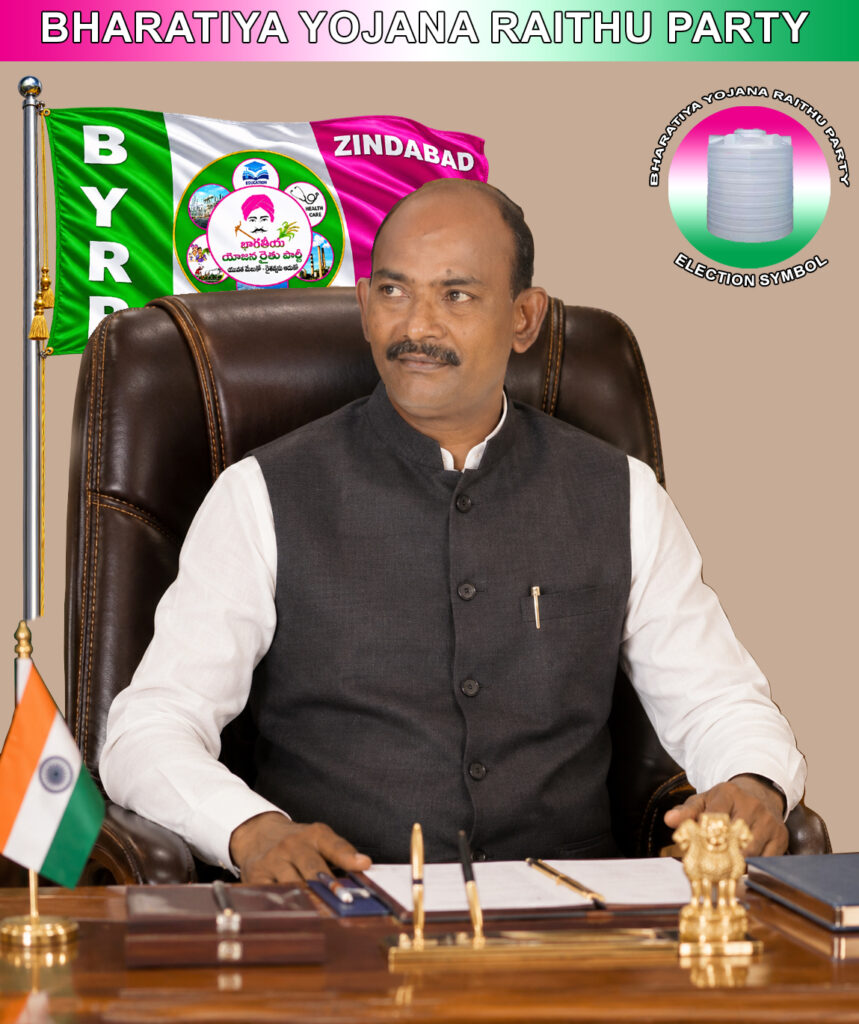
is a visionary Political Leader for a New India. the Founder and National President of Bharatiya Yojana Raithu Party Registered as National Party in India.
A Visionary Political Leader for a New India
Founder President — A Movement for Peace, Prosperity and People-Centred Development
India needs political leadership that looks beyond elections and short-term politics—a leadership committed to building a peaceful, prosperous, productive and united India where every citizen has the opportunity to live with dignity and contribute to national development.
The Founder President of this new political movement would stand for constitutional democracy, national unity, social harmony, economic opportunity and inclusive development. The vision would be rooted in the constitutional ideals of Justice, Liberty, Equality and Fraternity, which are fundamental to India’s democratic identity.
Our Vision
“A Strong, Prosperous and Harmonious India — Powered by Farmers, Youth, Entrepreneurs, Workers and Innovation.”
The objective is to create an India where:
- Farmers receive dignity, technology, better markets and higher value for their produce.
- Young people receive quality education, practical skills and meaningful employment for free upto post graduation.
- Industries create jobs while strengthening Indian manufacturing and exports.
- Entrepreneurs are encouraged to build businesses rather than depend on government employment.
- Villages become economically strong and connected to modern infrastructure.
- Every state and region receives opportunities for balanced development.
- Communities live together peacefully, respecting India’s diversity.
- Government becomes transparent, accountable and citizen-focused.
- Economic growth reaches ordinary families, not only large corporations.
- India becomes a global centre for agriculture, manufacturing, technology, knowledge and innovation.
Peace, Harmony and National Unity
The political movement would reject hatred, communal division and politics based on fear.
India’s strength is its diversity. The objective would be to create a political culture in which people of different religions, languages, castes, regions and communities can participate equally in national development.
The Founder President would promote:
- Respect for every citizen’s constitutional rights.
- Dialogue instead of confrontation.
- Equal opportunity without discrimination.
- Strong action against violence and corruption.
- Community programmes that bring young people from different backgrounds together.
- Greater cooperation between states and communities.
- A culture of patriotism based on service to the nation rather than hostility toward others.
The message would be simple: “Different identities, One India; Different aspirations, One Future.”
Agriculture as the Foundation of India’s Development
Agriculture would be one of the central pillars of the political vision.
Indian farmers should not remain only producers of raw commodities. They should increasingly participate in the entire agricultural value chain—production, storage, processing, branding, logistics, exports and retail. Recent agricultural policy discussions have also emphasized the importance of moving toward stronger agri-food value chains to improve farmer incomes and rural employment.
The proposed agricultural transformation would focus on:
- Modern irrigation and water conservation.
- Soil health and scientific farming.
- Agricultural research and technology.
- Climate-resilient agriculture.
- Better storage and cold-chain infrastructure.
- Food-processing industries close to farming regions.
- Farmer Producer Organisations and cooperatives.
- Direct market access and stronger agricultural supply chains.
- Crop diversification.
- High-value horticulture, dairy, fisheries and livestock.
- Agricultural exports.
- Digital agricultural services.
- Rural roads, logistics and connectivity.
- Greater opportunities for women and young people in agriculture.
“Farm to Factory to Global Market”
The goal would be to build rural economic ecosystems in which a farmer can produce, process and sell higher-value products rather than depending only on the sale of raw crops.
This would create farmer income + rural industries + youth employment + exports simultaneously.
Youth Development — India’s Greatest National Asset
India’s youth should be treated not merely as voters or beneficiaries of schemes, but as partners in nation-building.
The Founder President would establish a national youth development agenda based on:
Education → Skills → Employment → Entrepreneurship → Leadership
The programme would promote:
- Industry-linked vocational education.
- Apprenticeships.
- Modern technical training.
- Digital and AI skills.
- Engineering and manufacturing skills.
- Agricultural technology training.
- Entrepreneurship education.
- Start-up incubation in smaller cities and towns.
- Sports and physical development.
- Leadership and civic education.
- International employment and skill opportunities.
- Support for youth-led businesses.
India’s constitutional framework explicitly emphasizes equality of opportunity, while current youth initiatives also focus on social mobility, educational equity and practical skills. ([MyBharat][1])
Youth Employment Mission
A national Youth Employment Mission could bring government, universities, industries and entrepreneurs together to create a continuous pipeline from education to employment.
The objective would not be simply to create government jobs.
The objective would be to create millions of productive opportunities across agriculture, manufacturing, services, technology, construction, logistics, tourism and entrepreneurship.
Industrial Development and Job Creation
India needs industries that create large-scale employment as well as high-value technology.
The political vision would support:
- Manufacturing clusters.
- MSME development.
- Electronics and semiconductor industries.
- Food-processing industries.
- Textiles and garments.
- Pharmaceuticals and medical equipment.
- Renewable-energy manufacturing.
- Automobile and EV industries.
- Defence manufacturing within India’s legal and strategic framework.
- Machinery and engineering.
- Construction materials.
- Logistics and warehousing.
- Tourism and hospitality.
- Technology and software services.
Industrial development should extend beyond major metropolitan cities.
“One District — Multiple Economic Engines”
Every district should identify its agricultural, industrial, tourism, service and human-resource strengths and develop businesses around them.
This would encourage district-level specialization, local entrepreneurship and employment close to people’s homes.
Rural Transformation
India’s villages should not be viewed only as places from which people migrate to cities.
The objective should be to make villages economically productive, digitally connected and socially vibrant.
A modern village should have:
- Reliable roads and transportation.
- Quality schools.
- Healthcare facilities.
- Digital connectivity.
- Clean drinking water.
- Renewable energy.
- Modern agricultural services.
- Storage and processing facilities.
- Skill centres.
- Small industries.
- Financial services.
- Opportunities for women and youth.
The long-term objective is “Smart Villages connected to Smart Towns and Growing Cities.”
Wealth Creation for All
India needs economic growth that encourages people to become producers, entrepreneurs, investors, skilled workers and innovators.
The political philosophy would be:
“Create wealth, create jobs, create opportunity, and ensure that development reaches every section of society.”
This means supporting entrepreneurship while maintaining fair competition, consumer protection, labour dignity and the rule of law.
Government should create the conditions for people to succeed rather than attempt to control every aspect of economic activity.
Education for the Future
Education must prepare young Indians for the real economy of the 21st century.
The education system should strengthen:
- Mathematics and science.
- Technology and engineering.
- Vocational education.
- Agriculture and environmental sciences.
- Artificial intelligence and digital technologies.
- Entrepreneurship.
- Communication and languages.
- Critical thinking.
- Financial literacy.
- Constitutional values and civic responsibility.
Universities should have stronger partnerships with industries, research institutions and entrepreneurs.
Transparent and Accountable Governance
The Founder President would advocate clean, transparent and citizen-centred government.
Key principles would include:
- Zero tolerance for corruption.
- Transparent public procurement.
- Digital government services.
- Time-bound delivery of public services.
- Strong auditing and accountability.
- Evidence-based policymaking.
- Performance measurement for government programmes.
- Greater decentralisation where appropriate.
- Regular public reporting of major development projects.
The Constitution is the foundation of India’s democratic system and provides for fundamental rights, federal governance, separation of powers and free and fair elections.
Balanced Development Across India
No state, region or community should feel forgotten.
The political movement would work toward balanced development of:
North + South + East + West + Northeast + Rural + Urban India.
Investment should be encouraged according to each region’s strengths, including agriculture, manufacturing, technology, tourism, logistics, education and natural-resource-based industries while protecting the environment.
India as a Global Economic Power
The ultimate objective would be to build an India that is:
Food-secure
Energy-secure
Technologically capable
Industrially strong
Agriculturally prosperous
Economically competitive
Socially harmonious
Environmentally responsible
Youth-powered
Globally respected
India’s future should not be measured only by GDP. It should also be measured by farmer prosperity, quality employment, educational achievement, entrepreneurship, health, infrastructure, social harmony and the dignity of every citizen.
Universal and Affordable HealthcareHealthcare is an investment in the strength of the nation.
We will develop a nationwide network of primary healthcare centres, community hospitals, district hospitals, medical colleges, diagnostic centres, and specialised research institutions.
Major projects will include:
- Strengthening primary healthcare in every village and urban community.
- Modern district hospitals with emergency, maternal, child, and specialist services.
- Free or heavily subsidised essential healthcare for economically vulnerable citizens.
- Preventive health programmes, vaccination, nutrition, sanitation, and health screening.
- Telemedicine networks connecting rural communities with specialist doctors.
- Medical research centres focused on diseases affecting Indian communities.
- Development and manufacture of affordable medicines, medical equipment, and diagnostic technologies in India.
Our objective is simple: quality healthcare should be available to every Indian, regardless of income or location.
National Water Security Mission
Water security will be one of the central pillars of our development programme.
We will develop integrated water projects that connect water conservation, drinking water, agriculture, groundwater recharge, irrigation, sanitation, and environmental protection.
Major projects will include:
- Safe drinking-water supply to every rural and urban community.
- Large-scale rainwater harvesting and groundwater-recharge programmes.
- Restoration of lakes, tanks, ponds, canals, and traditional water systems.
- Modern irrigation and micro-irrigation projects.
- Watershed development in drought-prone regions.
- Scientific management of rivers and reservoirs.
- Water recycling and wastewater-treatment plants for cities and industries.
- Desalination projects where geographically appropriate.
- Smart water-management systems to reduce leakage and wastage.
- Community participation in protecting local water resources.
Every village should have dependable drinking water, and every farmer should have access to sustainable irrigation wherever technically and environmentally feasible.
Research and Technology for Public Development
Every major national project should be supported by research and measurable outcomes.
We will encourage universities, IITs, medical institutions, agricultural universities, public laboratories, startups, and industries to develop solutions for:
- Clean and affordable energy
- Water conservation
- Agricultural productivity
- Affordable healthcare
- Education technology
- Artificial intelligence
- Biotechnology
- Climate-resilient infrastructure
- Rural industries
- Waste management
- Sustainable cities
Public investment in research must ultimately translate into better lives, more employment, stronger industries, and greater national productivity.